Hot CVEs exploited in the wild: a roundup with PoC links
November was dense. In under a month CISA added dozens of flaws to its actively exploited list, and several of them combine into ready-made attack chains. We gathered the ones we consider most important, with CVE numbers, status and a note on whether public code demonstrating the problem exists. This is not an attack guide, it is a patching priority list and a map of where to find reliable sources.
Context and legality. We do not link directly to working exploits. For each flaw we give a source and a note on public PoC availability. You will find research code for a specific number in the aggregators listed at the end, by searching the CVE. Testing systems you do not own is legal only with the owner's written authorisation.
PHP and Linux: the chain to root
- PHP2Shell (CVE-2026-109618 and CVE-2026-109619): remote code execution in the PHP core, CVSS 9.2, CISA KEV 26 October. A public PoC exists but does not work on a default install, an additional file inclusion bug is usually needed. Source: Sansec. More in our PHP2Shell analysis.
- Fragnesia (CVE-2026-46300): Linux kernel local root, CVSS 7.8, CISA KEV 28 October. A public PoC has been available since May. Chained with PHP2Shell to turn a web shell into root. Source: Rescana. More in our Fragnesia analysis.
Edge and VPN devices
- Barracuda ESG (CVE-2026-116606 and CVE-2026-111560): an authorization bypass plus command injection to root, CISA KEV 10 November. Source: Rescana. More in our Barracuda analysis.
- Cisco ASA and FTD (CVE-2026-76418): an unauthenticated SSL VPN reload, CVSS 8.6, CISA KEV 29 October. Source: BleepingComputer.
- Ivanti Connect Secure (CVE-2026-111357 and CVE-2026-118527): missing authentication and a file upload, CISA KEV 30 October.
- SonicWall SonicOS SSLVPN (CVE-2026-19868): a bypass of MFA enforced through SAML, CISA KEV 6 November. Source: BleepingComputer.
- Check Point Gaia OS (CVE-2026-123039): incorrect permissions, local root, CISA KEV 13 November. We break down the set in our review of the edge attack wave.
Others worth knowing
- OpenSSH sshhole (CVE-2026-123158): a password login bypass on musl without PAM, meaning Alpine and containers, CVSS 8.1, CISA KEV 9 November. A public PoC is available. More in our sshhole analysis.
- WordPress Core (CVE-2026-119977): a race condition during an upgrade leading to unauthenticated code execution, CISA KEV 3 November.
- Plex Media Server (CVE-2026-96652, 96654, 96655, 96656): SSRF and an admin file write, CISA KEV 20 October. A public PoC since 16 October.
Worth watching, though not yet exploited
For fairness we add one critical flaw that is not confirmed as exploited today, but is too serious to wait on.
- Apache HTTP/2 (CVE-2026-119618): a critical RCE through a race condition in HTTP/2 handling, patched on 11 November in 2.4.71. As of 12 November neither Apache nor the reviewed reports documented exploitation in attacks, and there was no public working exploit. It is worth patching ahead of time. Source: SOC Prime.
Where to find PoCs
For a specific CVE number, research code is easiest to find in a few fixed places. Search by number, not by name.
- Exploit-DB as the classic exploit and PoC database.
- nomi-sec/PoC-in-GitHub, an aggregator of PoCs published on GitHub, organised by CVE number.
- trickest/cve, a similar collection of links to PoCs on GitHub.
- CISA KEV as the source of exploitation status and patch deadlines.
Keep two things in mind. The presence of a PoC does not mean the exploit will work in your environment, and its absence does not mean you are safe. Set priority by exploitation status and exposure, not by whether someone pushed code to GitHub.
How to read this list
The CISA KEV list has one advantage over a plain stream of CVEs. It does not say what might be dangerous, it says what is already being used. That turns it from an academic ranking into a practical task queue. When you read it, look first at what you run and what is visible from the internet, and only then at the CVSS score. A 7.8 flaw that someone actually uses in a chain is more urgent than a critical 9.8 that needs conditions you do not have.
How to set priorities
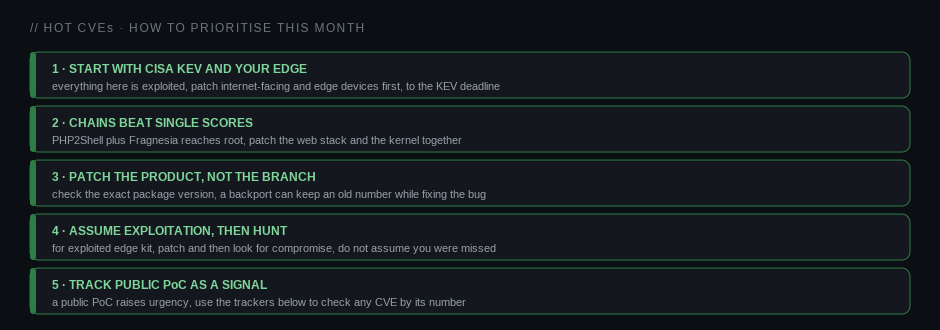
- Start with CISA KEV and the edge. Everything on that list is exploited. Edge devices and anything visible from the internet first, to the KEV deadline.
- Think in chains. PHP2Shell plus Fragnesia yields root. Patch the web server and the kernel together, not separately.
- Patch the package, not the branch. Check the specific package version. A backport can keep an old number even though the flaw is already closed.
- Assume exploitation and hunt. For exploited edge kit, look for signs of compromise after patching, do not assume you were missed.
- Treat a PoC as a signal. Public code raises urgency. Use the aggregators above to check any number.
What this means
The CISA KEV list is, in practice, a ready-made task queue. If something is on it, it means someone is already using it, not that they could. For NIS2 this is directly the vulnerability management from Article 21, where the patch itself and the reaction time both count. The most dangerous thing this month is not the individual flaws but their combination, which is why priorities are best set by the real attack path, not by the CVSS score alone.
If you want someone to look at your attack surface with exactly these chains in mind and tell you what to patch first, that is the scope of our penetration testing and attack-surface review. We gathered the requirements on the NIS2 / KSC page. Book a consultation.
Sources: CISA KEV · Safeguard (KEV roundup) · Sansec