The edge attack wave: Cisco, Ivanti, SonicWall and Check Point in one month
If you had to point to one place where the most happened this month, it would be edge devices. Firewalls, VPN gateways and access appliances sit by definition at the boundary between the internet and the internal network, so they make an attractive target. Between late October and mid-November CISA added to its actively exploited list flaws in kit from Cisco, Ivanti, SonicWall and Check Point. This is not one vulnerability, it is a recurring pattern.
Context and legality. This is a roundup based on CISA KEV entries and reporting by BleepingComputer and SecurityWeek. We do not publish exploits. We gather the numbers and describe what to do so you do not become the next entry on the list. Testing systems you do not own is legal only with the owner's written authorisation.
What exactly reached the list
In a window of under three weeks, the actively exploited list gained:
- Cisco ASA and FTD (CVE-2026-76418): an unauthenticated reload of the SSL VPN service, a denial of service. Scored 8.6, added 29 October. It is already the second firewall zero-day for Cisco since August.
- Ivanti Connect Secure (CVE-2026-111357): missing authentication leading to privilege escalation, added 30 October.
- Ivanti Connect Secure (CVE-2026-118527): predictable identifiers allowing an authenticated user to upload a file, added 30 October.
- SonicWall SonicOS SSLVPN (CVE-2026-19868): a login path that bypasses the multi-factor authentication enforced through SAML, added 6 November.
- Check Point Gaia OS (CVE-2026-123039): an incorrect permission assignment that yields local root, added 13 November.
The common thread
There is a rhythm here too. This is already the second firewall zero-day for Cisco this year, and Ivanti and SonicWall have been returning to the list regularly for months. Attackers have learned that access devices are the shortest road into the network, because they have to be reachable from the internet while also granting broad access.
These flaws differ in mechanism, but they share a location. All of them affect kit that sits at the edge and often has a management panel visible from the internet. The most dangerous in this set is the SonicWall case, because bypassing enforced MFA strikes at a mechanism many companies base their entire remote-access security on. The Cisco flaw looks milder, since it is a denial of service, but repeated, unexplained reloads of a VPN gateway can be exactly a sign of attack rather than a fault. The Check Point case, in turn, is a reminder that local root on the firewall itself turns an incident into a full takeover of the device that controls the traffic.
For defence this means a simple thing. Logs and telemetry from the edge devices themselves matter as much as from servers, and they are often neglected. A gateway reload, failed attempts to log in to the panel or a sudden rise in traffic on the management port are signals that should reach monitoring.
How to defend
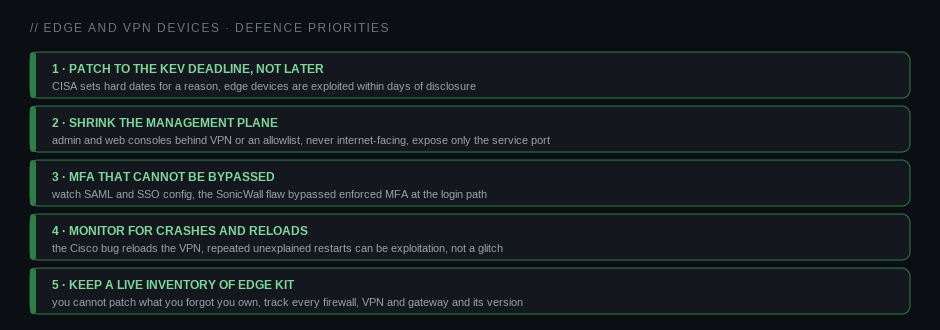
- Patch to the CISA KEV deadline. Those dates are not nominal. Edge devices tend to be attacked within days of a flaw being disclosed.
- Shrink the management plane. Put admin and web consoles behind a VPN or an allowlist. Leave only the service port exposed.
- Ensure MFA that cannot be bypassed. Check the SAML and SSO configuration. The SonicWall flaw bypassed exactly the enforced MFA at the login path.
- Monitor reloads and crashes. Treat sudden, unexplained VPN gateway reloads as a possible incident, not a minor glitch.
- Keep a live inventory. You cannot patch kit you have forgotten. Track every firewall, gateway and VPN device along with its version.
What this means
Edge devices are the front line today, and attackers know it well. For NIS2 this is directly the area of vulnerability management and access control, and patching speed here is a measure of maturity, not a formality. We broke down a similar case, the takeover of a security appliance, in our analysis of the Barracuda device flaws, and the full picture of the month is in our review of hot CVEs.
There is a simple asymmetry in this. The defender has to get the patch out before the attacker uses the flaw, and the attacker often moves within days of disclosure. That is why, with edge devices, having a patching process is not enough, you need a fast patching process, with a clear owner and a maintenance window ready for yesterday.
If you want to know which of your edge devices are visible from the internet and whether their configuration would survive a month like this, that is the scope of our penetration testing and attack-surface review. Book a consultation.
Sources: CISA KEV · BleepingComputer (Cisco) · BleepingComputer (SonicWall) · SecurityWeek