OpenSSH sshhole: a password login bypass on Alpine and musl
OpenSSH is probably the most widely used remote access server in the world, so any login flaw makes an impression. CVE-2026-123158, named sshhole, looks alarming at first glance, because it bypasses password login. In practice, though, it affects a narrow but specific group of systems: those built on the musl library, which above all means Alpine Linux, with PAM disabled. That means container images are the most exposed.
Context and legality. This is educational material based on Greenbone's analysis, Alpine's data and the CISA KEV warning. We focus on the exposure conditions and the patch, not on exploit code. Testing systems you do not own is legal only with the owner's written authorisation.
Who is affected
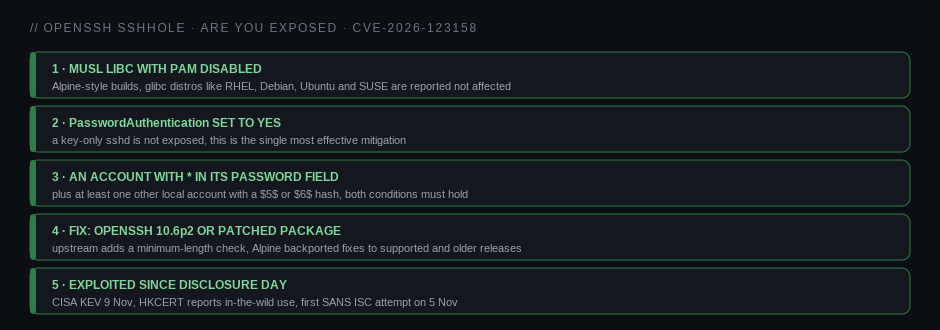
The conditions all have to hold at once. The system uses the musl library and sshd runs without PAM. Password login is enabled. At least one account has an asterisk in its password field, and at least one other local account has a hash in the $5$ or $6$ format. glibc-based distributions, including Red Hat, Debian, Ubuntu and SUSE, are reported not affected. That is why all the attention is on Alpine and on container images that use it.
What it is
The mechanism can be described without giving attack instructions. On musl the password-hashing function returns an asterisk for an over-long input. For accounts that have an asterisk in the password field, sshd's comparison then succeeds. In other words, an account that was meant to be locked can be logged into. OpenSSH 10.6p2 adds a minimum-length check on the stored hash and closes that path. The OpenSSH project notes that the root cause lies outside sshd itself, but that it is exploitable through sshd and can be fixed there too.
How to check in practice
The quickest test is to look at the sshd configuration and the accounts. If PasswordAuthentication is set to no, the issue essentially disappears, because the attack needs password login. If passwords are enabled, check whether sshd runs without PAM and whether the system is built on musl, which in practice means Alpine. Finally, review the password file for accounts with an asterisk next to accounts with hashes. If all those conditions hold, you have real exposure and the patch is urgent. Across a fleet of containers it is worth automating this, because checking every image by hand does not scale.
Is it being exploited
Yes. CISA added the flaw to its actively exploited list on 9 November. HKCERT reports in-the-wild use, and the SANS Internet Storm Center recorded a first attempt on 5 November, the disclosure day. Public code demonstrating the problem is available. The score is 8.1 on CVSS. The flaw moved out of the theoretical phase quickly, which matters for internet-facing container images, since those are run at scale and rarely updated.
For detection it is worth watching for unusual successful logins to accounts that should not normally log in with a password, and logins with long, unusual passwords. In the sshd logs such events can be caught, especially if you account for entries that were meant to be locked.
How to defend
- Update OpenSSH to 10.6p2. On Alpine install the fixed package. Alpine backported the patch to older supported releases too, so the version number alone does not always show exposure.
- Disable password login. Set PasswordAuthentication to no and use keys. This closes the flaw regardless of the other conditions and is the single most effective step.
- Review local accounts. Check whether you have accounts with an asterisk in the password field next to accounts with hashes. That combination is the condition for the attack.
- Rebuild container images. If you rely on Alpine, update the base image and ship new versions. An old image in the registry still carries the old flaw.
What this means
Sshhole is a clear reminder that a container inherits the vulnerabilities of its base image, and Alpine is everywhere in the Docker world. A single flaw in a system library can therefore reach thousands of images at once. The good news is that the defence is simple: key-based login instead of a password closes the matter before you even count the remaining conditions. We gathered the full picture of this month in our review of hot CVEs.
There is a broader software supply chain lesson here too. A base image you use across dozens of services is a single point that, with one flaw, touches all of them at once. That is why it is worth knowing what you build on and having a way to rebuild and ship images quickly when such a vulnerability appears.
If you want to know which of your SSH services and container images are exposed to the internet and how they are configured, that is the scope of our penetration testing. Book a consultation.