Barracuda: two flaws turn ESG email gateways into a path to root
Barracuda is one of those vendors whose kit sits at the edge of the network and is meant to see malicious mail before it reaches a user. On 2 November the company shipped fixes for two flaws that together turn such a device from a shield into a way in. Eight days later, on 10 November, CISA added both to its actively exploited list. This is a scenario Barracuda knows from 2023, when its ESG email gateways were mass-exploited.
The numbers are CVE-2026-116606 and CVE-2026-111560. On their own each needs certain conditions. Chained on the ESG device they give an unauthenticated attacker full root on a box that by definition has access to all of a company's mail.
Context and legality. This is educational material based on Barracuda's advisory, the CVE records published by Mandiant and the CISA KEV warning. We do not publish an exploit. We describe what was fixed and why it has to be done quickly. Testing systems you do not own is legal only with the owner's written authorisation.
Two flaws, one chain
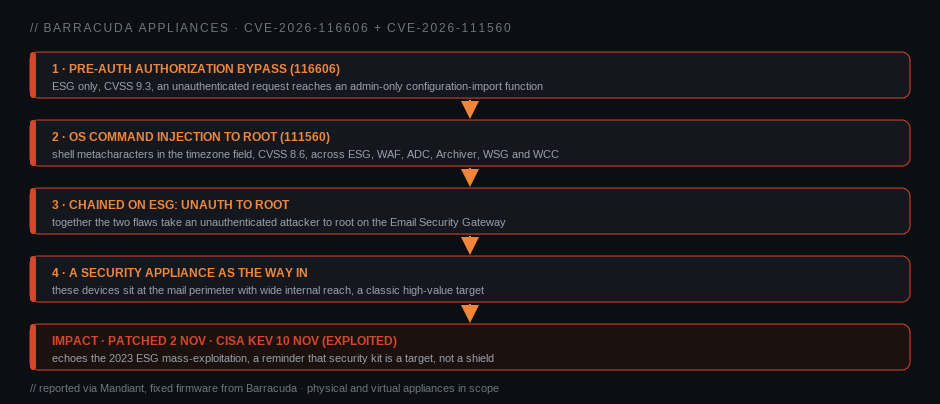
CVE-2026-116606 is a pre-authentication authorization bypass, affecting only the ESG gateway, rated 9.3. It lets an unauthenticated request reach a configuration-import function that is normally available only to an administrator. CVE-2026-111560 is an OS command injection through shell metacharacters in the timezone configuration field, rated 8.6. It allows commands to run with root rights.
Barracuda says that exploiting each flaw on its own requires access to the administrative interface. The catch is that on the ESG the first flaw removes that requirement. The authorization bypass opens the way to an administrative function, and the command injection turns that access into root. Put together, they give a full path from an unauthenticated request to a device takeover.
This is a classic, dangerous combination. A flaw that requires an administrator is often treated as less urgent, on the assumption that the attacker would have to log in first anyway. The authorization bypass overturns that assumption. So when we rate two flaws together, we do not add up their scores, we check whether one removes the condition of the other. Here it does.
Which devices are in scope
The authorization bypass (116606) affects only the ESG email gateway. The command injection (111560) has a wider reach and covers ESG, the Load Balancer ADC, the Message Archiver, the Web Application Firewall, the WAF Control Center and the Web Security Gateway. Both physical and virtual appliances are in scope. That matters for inventory, because it is easy to remember the box in the server room and forget its virtual twin running in the cloud.
How to check whether you are exposed
Start with inventory. List every Barracuda device in the organisation, physical and virtual separately, along with the firmware version and whether its admin panel is reachable from the internet at all. On the ESG both flaws apply, on the other models mainly the command injection. If any device has a panel visible from outside, treat it as a priority, because that path is the target. Check too for old, forgotten virtual instances, since those are the easiest to miss when patching.
After patching, do not assume the matter is closed. Review the device logs and the vendor's guidance on signs of compromise, and watch for unusual accounts, configuration changes and unexpected outbound traffic. If the panel was exposed to the internet, take seriously the possibility that someone reached it in time, and rotate the secrets and certificates the device held.
Why it is serious
A security appliance at the edge of the network is a tempting target. It sees traffic, it is widely trusted inside, and it often sits where all of an organisation's mail passes through. Taking over such kit gives an attacker a position that is hard to dislodge. Barracuda went through this in 2023, when its ESG gateways were mass-exploited by a group tracked as UNC4841, and some devices had to be replaced because a patch alone was not enough. Nobody has publicly attributed the current attack to that group, but the CISA listing means the flaws are being used in practice, not just in theory.
It is worth spelling out why the 2023 campaign is a good reference point here. The UNC4841 group used a single ESG flaw for a mass break-in, and on some devices it left persistent access that survived updates. That is why the vendor recommended at the time not a patch alone, but in some cases replacing the hardware. That lesson still holds. With a security appliance a patch is a necessary step, but not always enough if the attacker has had time to settle in.
How to defend
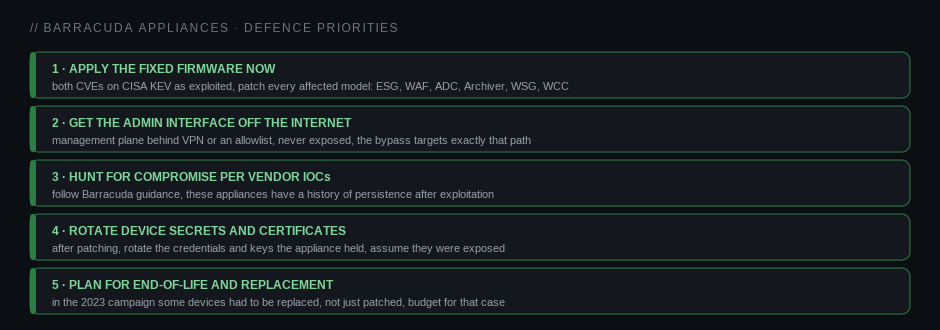
- Install the fixed firmware. Both flaws are on the CISA list as exploited. Update every affected model: ESG, WAF, ADC, Message Archiver, Web Security Gateway and WAF Control Center.
- Take the admin interface off the internet. Put the management plane behind a VPN or an allowlist. That path is exactly what the authorization bypass targets.
- Hunt for signs of compromise. Check the vendor guidance and the logs. These devices have a history of attacker persistence after a break-in.
- Rotate device secrets and certificates. After patching, replace the credentials and keys the device held. Assume they may have been exposed.
- Plan for end-of-life replacement. In the 2023 campaign some devices had to be replaced, not just patched. It is worth budgeting for that case.
What this means
The hardest lesson from incidents like this is simple: security kit is a target too, and sometimes an easier target than what it is meant to guard. For NIS2 this is a double theme. On one side your own vulnerability management and inventory of edge devices, on the other supply chain risk, because this is a third-party vendor's product wired into the very middle of company mail. We cover the same pattern, a month full of edge-device holes, in our review of the edge attack wave.
There is a broader truth here that is easy to forget at purchase time. Every device you add to the network to improve security also enlarges the attack surface. That is not an argument against such products, just a reminder that they have to be patched, monitored and kept off the internet the same as any other server, perhaps more carefully, because they sit in a sensitive spot.
We gathered the requirements on the NIS2 / KSC page. If you want to know which of your edge devices, physical and virtual, are visible from the internet and how they are configured, that is the scope of our penetration testing and attack-surface review. Book a consultation.