Empty shelves at Albert Heijn and a week of attacks on European retail
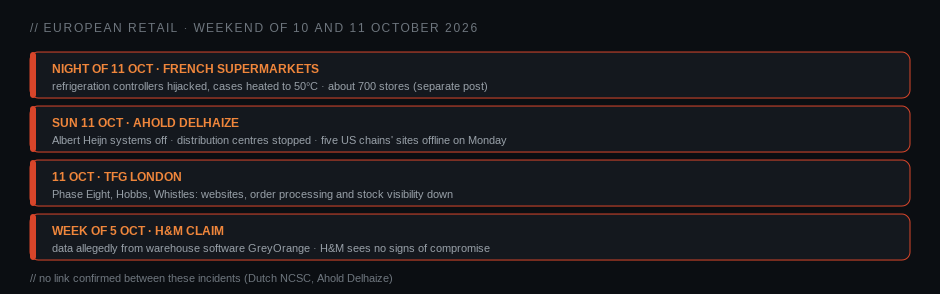
On the afternoon of Sunday 11 October, Ahold Delhaize took part of the systems of Albert Heijn, the largest supermarket chain in the Netherlands, offline. Over the following days some distribution centres stopped, the online store went down and stores started running out of some products. The same weekend someone hijacked refrigeration controllers in hundreds of French supermarkets, and the UK group TFG London was dealing with an attack on the systems of its Phase Eight, Hobbs and Whistles brands. In the background, H&M was checking claims of an alleged leak.
This need not be a single campaign, and the Dutch NCSC sees no reason to link the events. Still, one week shows clearly how quickly an IT incident in retail turns into an empty shelf.
Context and legality. This is educational material based on company statements and reporting by NL Times, DutchNews, Euronews, BleepingComputer and Cybernews. The type of attack on Ahold Delhaize has not been confirmed, and the H&M leak claims are unverified. We keep the two apart. Testing systems you do not own is legal only with the owner's written authorisation.
Albert Heijn: what stopped working
Ahold Delhaize speaks only of a "cybersecurity incident". The effects, however, are easy to see. In the Netherlands some of Albert Heijn's six distribution centres stopped. According to an email seen by RTL Z, only the Zaandam centre was running, although the company has not confirmed this. The Albert Heijn online store and website were down, as were the Etos and Gall & Gall websites. In Belgium, Albert Heijn stores supplied from the Tilburg centre could run short, and Delhaize reported IT problems. On Monday the websites of five US chains in the group, including Stop & Shop and Food Lion, were also offline, and online orders and deliveries were suspended.
Margaret Versteden-van Duijn, the Ahold Delhaize executive responsible for Albert Heijn, told NOS that shelves "will empty" if the outage continues. According to Euronews, stores and distribution centres hold about six days of supply between them. On 13 October the group said it had so far found no evidence that customer, employee or third-party data had been stolen, and began a controlled restart of some systems.
What is known about the attack itself
Not much. The company has not said whether it is ransomware and has named neither a vector nor a perpetrator. Experts speaking to Dutch media consider a break-in very likely. Pim Takkenberg said it seemed fairly clear that someone malicious had been in the system. Eward Driehuis wondered whether the company had found a weakness it could not fix quickly and shut systems down as a precaution. NOS reported that Albert Heijn identified servers used in the attack in the US, Poland, Moldova and Turkey, stressing that this says nothing about where the attackers are. Takkenberg said such servers are usually used for reconnaissance or data exfiltration.
According to DutchNews, the police publicly urged Ahold to file a report. Warnings about phishing that impersonates the chain followed too, which almost always happens after incidents like this.
TFG London and H&M
TFG London, the owner of Phase Eight, Hobbs and Whistles, detected its incident on 11 October and disclosed it on 13 October. The brands' websites, order processing and stock visibility were down. Physical stores kept trading normally, and the company has no confirmed evidence of customer or payment data exposure.
H&M is the opposite case: there are claims but no confirmed incident. A dataset attributed to ShinyHunters appeared on forums, but Cybernews found that the group's account on that forum was inactive and there was no matching post. The sample contained a few product records that researchers linked to GreyOrange warehouse software, which H&M uses. H&M itself says it sees no signs of compromise. For now this looks more like an extortion attempt by someone posing as a well-known group than a confirmed leak.
The common thread: logistics and suppliers
Even if these events have no common perpetrator, they share a lesson. In retail, IT is logistics. When ordering systems and distribution centres stop, stores have a few days of stock and then the shelves empty. On top of that, more and more critical functions run at suppliers: refrigeration controllers serviced by an outside company, warehouse software like GreyOrange, e-commerce platforms. An attack does not have to hit the retailer itself, hitting its supplier is enough.
How to defend
- Separate logistics from the rest of IT. Warehouse systems, control systems and the store network in separate zones, so an incident in the office does not stop the distribution centres.
- Rehearse the fallback mode. Manual orders, printed routes, contact with suppliers without the system. A plan nobody has rehearsed will not work on a Sunday afternoon.
- Recovery measured in hours. Backups of ordering and WMS systems outside the production admin domain, with a tested restore time.
- Review supplier access. Who has remote access to your systems and devices, with which accounts, from where, and who knows about it.
- Prepare communication for the phishing wave. After every high-profile incident, fake messages "from the store" follow. A ready-made notice for customers shortens that window.
What this means
Food distribution is in Annex II of NIS2, and the risk management duty covers the supply chain. This week shows why. We cover the technical side of the French attack in our analysis of the fridge attack, and integration risk in e-commerce in the BigCommerce incident.
If you want to check whether an office incident could stop your warehouses, or who has access to your systems from outside, that is the scope of our penetration testing and attack-surface review. Book a consultation.
Sources: NL Times · DutchNews · DutchNews (police) · Euronews · BleepingComputer (TFG London) · Rescana (TFG London) · Cybernews (H&M)