The fridge attack: hijacked refrigeration controllers in hundreds of supermarkets
On the night of 11 October someone remotely took over refrigeration controllers in hundreds of French supermarkets and told them to heat instead of cool. Display cases and freezers reached 50°C, equipment in some stores started to burn, and in the morning staff threw away whole batches of meat and frozen food. According to Finance Minister Roland Lescure, about 700 of France's roughly 10,000 supermarkets were hit. A Sekoia analyst told Reuters that stores in Spain, Portugal, Germany, Belgium and Poland were affected as well.
The incident is a clear picture of neglected OT in retail. Nobody encrypted anything and nobody asked for a ransom. A few changed parameters in devices that had been reachable from the internet for years were enough.
Context and legality. This is educational material based on the CERT-FR alert, company statements and reporting by Reuters, Le Monde and the trade press. We separate facts from hypotheses: as of today nobody knows how the attackers got into the controllers, and nobody has claimed the attack. We do not publish instructions for finding or exploiting these devices. Testing systems you do not own is legal only with the owner's written authorisation.
What happened
The attack came over the weekend, at night, when the stores were closed. On Monday 12 October the chains confirmed the incident, and CERT-FR, the response team at ANSSI, issued alert CERTFR-2026-ALE-012 about compromised Danfoss controllers from the AK-SM and AK-SC series. A day later it added Copeland and Dixell XWEB systems (Dixell belongs to Copeland). So this is not a single-vendor problem.
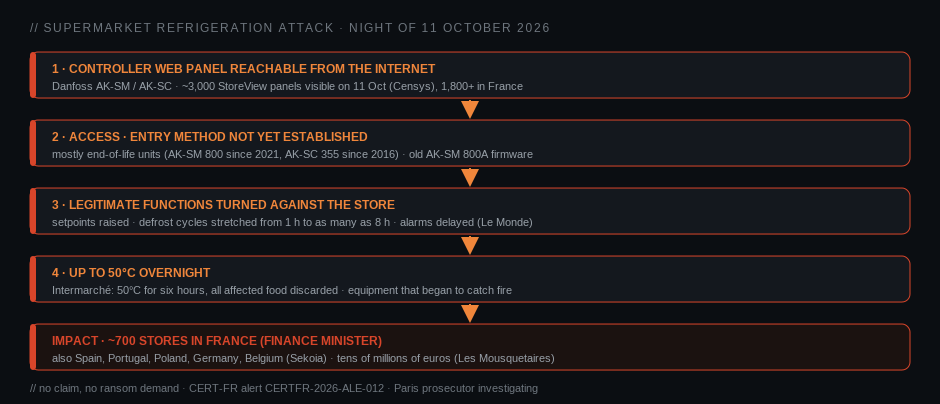
The list of victims is long. For Intermarché and Netto, part of Les Mousquetaires, AFP reported 300 stores or more, while Reuters put it at about 150. Carrefour confirmed 80 supermarkets and Coopérative U 80 of roughly 2,000 stores, with only a minority of those losing stock. Monoprix (about 30 locations), several E.Leclerc stores and, per Reuters, Auchan were hit too. Intermarché said its units ran at 50°C for six hours and everything in them was discarded.
The first loss estimates are in. Two supermarkets in Alsace put theirs at €270,000 combined, and Les Mousquetaires CEO Thierry Cotillard talks about "tens of millions of euros" across the country. The Paris prosecutor opened an investigation on its own initiative, led by its cybercrime section, and the description of damage includes equipment that "began to catch fire". Coopérative U CEO Dominique Schelcher called it a matter of extreme gravity, without precedent.
Which devices, and why these
A supermarket controller is usually a central panel that watches the temperature of every display case and freezer, runs the defrost cycles and raises alarms. Service technicians manage it remotely through a browser. If that panel can be reached from the internet, whoever takes it over decides the temperature of the whole store.
Danfoss says most of the affected devices are older models. The AK-SM 800 has been out of support since May 2021, the AK-SC 355 was discontinued in 2016, and neither gets patches anymore. Some victims, though, ran the current AK-SM 800A on outdated firmware.
Claroty studied that last model in August. It described three 2025 vulnerabilities: CVE-2025-41450 (authentication bypass in versions before 4.2), CVE-2025-41451 (command injection leading to remote code execution, requires login, fixed in 4.3.1) and CVE-2025-41452 (denial of service, also after login, fixed in 4.3.1). Claroty showed they can be chained and found thousands of AK-SM 800A interfaces reachable from the internet. In the Copeland XWEB Pro controller the same firm had earlier reported 23 vulnerabilities, which the vendor patched.
Precision matters here. Neither the French authorities nor Danfoss have tied the attack to these flaws. The CERT-FR alert names no specific vulnerability. A person close to the Prime Minister said only that ANSSI found a weakness in a Danish company's software and contacted the vendor. The entry method is still unknown.
What exactly the attackers did
The most interesting technical point is that the attackers did not need malware in the usual sense. They used functions the controller has by design. According to Le Monde they stretched defrost cycles from one hour to as many as eight, which delayed the alarms, and raised the temperature setpoints. The units did exactly what they were told. The alarm system that should have woken someone at night lived in the same hijacked panel.
From a penetration testing point of view this is a classic OT problem. The integrity of control logic matters more here than data confidentiality, and in many installations the only control is a password to a web panel. Against a target like this an attacker does not need to encrypt anything. Changing a few numbers at night, when nobody is watching, and waiting for the morning is enough.
How many of these devices are online
Plenty, and device search engines show it. Censys saw nearly 3,000 Danfoss StoreView panels on the internet on 11 October, more than 1,800 of them in France. By 14 October the French count had dropped to 537 as stores rushed to disconnect them. Reuters counted at least 4,500 Danfoss interfaces online on Tuesday (a different methodology, so the two numbers are not directly comparable), and Onyphe notes that outdated versions are still common among them. Ken Munro of Pen Test Partners put it briefly: "This is about basic cyber hygiene."
Common weaknesses in these installations
Most of the problems in store and warehouse networks are well known and need no zero-day. Refrigeration controllers, camera recorders and point-of-sale systems on one flat network. A service technician's LTE modem plugged in on the side, outside the company firewall. A web panel with a default account, or one password for every store in the chain, because the technician has to get in at any hour. A device nobody updates because it works and nobody wants to touch it. Any one of these is enough for an outsider to change the setpoints.
Who is behind it
Nobody knows. No one has claimed the attack, there has been no ransom demand, and the prosecutor is still counting victims. The hybrid warfare angle came up quickly, since in September President Macron ordered critical infrastructure to be protected against Russian "hybrid attacks". No official source has attributed this incident to Russia, though. Ken Munro even suggested it could be "kids messing around". The absence of a financial demand fits sabotage as well as vandalism, so any attribution at this stage is speculation.
Liability is a separate thread. Les Mousquetaires says Danfoss managed the systems and the supplier should file the complaint. E.Leclerc talks about an unnamed refrigeration equipment supplier that was hit. If a service company with remote access looks after the controllers in practice, its accounts, its VPN and its procedures become part of the store's attack surface.
Not the first time
In an October 2025 newsletter Danfoss itself recalled two cases from 2022: an attack on 16 Russian supermarkets using the AK-SM 800 and a break-in at 40 stores in Israel that had neither a firewall nor a VPN in front of their controllers. The warnings had been around for years, and so had the list of unsupported devices.
Poland on the list
Félix Aimé of Sekoia told Reuters that stores in Spain, Portugal, Germany, Belgium and Poland were affected as well. He gave no details, and no Polish chain has publicly confirmed an incident. That is no reason to relax. If the attack reached Poland, the same controllers run there in stores, wholesale warehouses and cold stores, and their panels are sometimes exposed to the internet "just for a moment" for servicing. If you run a retail chain, a warehouse or a food processing plant, check today whether your controllers are visible from outside.
How to defend
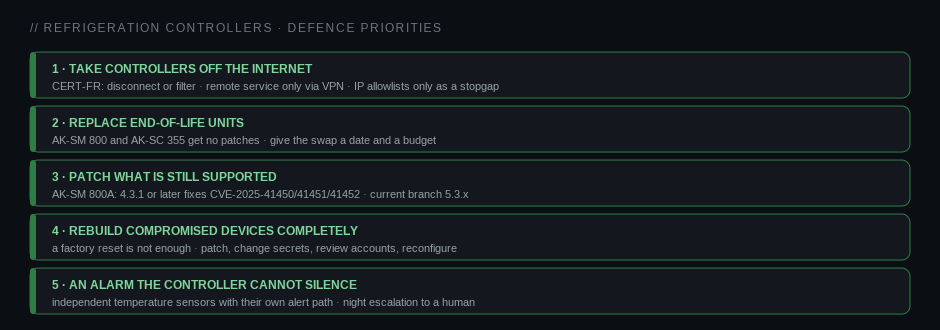
The first four points are CERT-FR's recommendations, the fifth is ours. They apply to any refrigeration installation, Danfoss or not.
- Take controllers off the internet. Disconnect them or filter access. Remote servicing only through a VPN or a protected network. CERT-FR accepts IP filtering only as a temporary measure.
- Replace unsupported units. The AK-SM 800 and AK-SC 355 will not get patches. If they must keep running, keep them on a network cut off from the internet, and give the replacement a date and a budget.
- Patch what is still supported. On the AK-SM 800A, version 4.3.1 or later closes the vulnerabilities above. The latest package is 5.3.x, and systems on the 3.x branch have to move to 4.x first.
- Rebuild a compromised device completely. A factory reset alone is not enough, because the device stays vulnerable. CERT-FR recommends this order: restrict service provider access, reset, apply all fixes, new secrets, review accounts, full reconfiguration.
- Put an alarm outside the controller. An independent temperature sensor with its own alert channel cannot be switched off from the same panel. Write night-time response times and remote access rules into the service contract.
What this means
A fridge attack sounds like a curiosity until you count the losses: destroyed stock, damaged equipment, fire risk and a broken cold chain, which makes it a food safety issue. For NIS2 this is nothing exotic. Food processing and wholesale distribution are in Annex II of the directive, and the supply chain requirements extend to suppliers and service companies with remote access to such devices. In our review of recent RCE flaws we wrote that a single management panel exposed to the internet can give an attacker more than many servers. Here that panel controls the temperature of food.
We covered the requirements on the NIS2 / KSC page. If you want to know which of your OT and IoT devices can be seen from the internet, and what can be done with them before someone else checks, that is exactly the scope of our penetration testing and attack-surface review. Book a consultation.
Sources: The Hacker News · SecurityWeek (first reports) · SecurityWeek (Copeland and Dixell) · Al Jazeera · Euronews · Schneier on Security