ShinyHunters versus the FBI and Clop: one group's September
In September the ShinyHunters group did two things that caught the whole industry's attention. On 18 September it took over and defaced the leak site of the Clop gang, one of the best known extortion groups. On 22 September it announced it had broken into FBI systems through a previously unknown vulnerability in Oracle PeopleSoft. The first is confirmed. The second remains largely a claim.
Context and legality. This is educational material based on reporting by BleepingComputer, The Next Web, 404 Media and Cybernews. Most technical details come from the attackers themselves, and we describe them as such. We do not give addresses of criminal sites. Testing systems you do not own is legal only with the owner's written authorisation.
Clop in the crosshairs
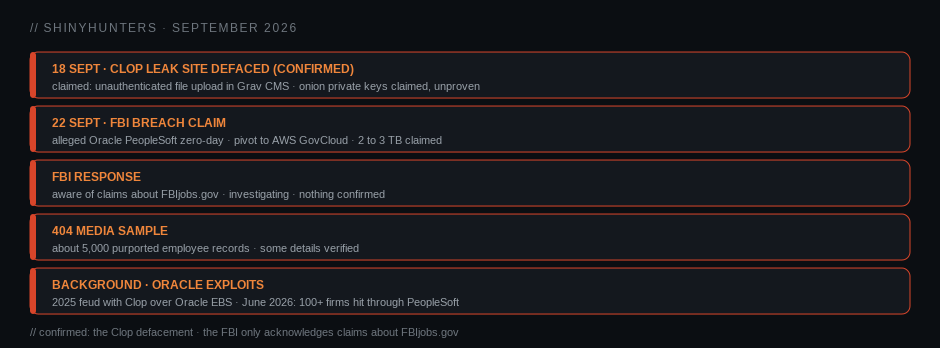
On the night of Friday 18 September, visitors to Clop's Tor site saw Pokémon artwork and a message saying the site had been taken over by ShinyHunters. BleepingComputer confirmed the defacement was live on Clop's infrastructure and that the attackers had uploaded a downloadable file there. ShinyHunters claim they used an unauthenticated file upload in Grav, the CMS behind the site, and took source code, plugins, logs and the private keys of the onion service. Those keys would let them impersonate Clop's address, but they have shown no proof. They gave Clop 72 hours. Clop has stayed silent.
The feud has a history. ShinyHunters claim the Oracle E-Business Suite exploit Clop used in October 2025 was originally their work. Earlier, as part of the Scattered Lapsus$ Hunters group, they published a proof of concept that Oracle later confirmed matched the exploit used in the attacks.
The FBI in the crosshairs
On 22 September ShinyHunters announced they had entered FBI systems through an alleged Oracle PeopleSoft zero-day allowing remote code execution, and then moved into FBI-managed AWS GovCloud infrastructure. They claim to have stolen 2 to 3 TB of data, including records on current and former employees and job applicants, and to have reached several internal systems. The apply.fbijobs.gov site was reportedly replaced with their artwork. As a motive they cited retaliation for an FBI warning about them from May 2026 and gave the Bureau a week to withdraw it, denying that this was extortion.
The FBI said it is aware of claims of unauthorised activity affecting FBIjobs.gov and is investigating. It confirmed neither a breach nor data theft. 404 Media received a sample of about 5,000 purported FBI employee records and verified some details, such as phone numbers matching the names of people linked to the Department of Justice. Oracle has not confirmed a new vulnerability.
What is actually confirmed
The Clop defacement: yes. A file uploaded to that site: yes. Clop's onion keys and source code: only a claim. The FBI breach: the FBI speaks of claims and is investigating, the 404 Media sample is partly credible, and the PeopleSoft zero-day has neither a CVE number nor confirmation from Oracle.
ShinyHunters' track record makes them more credible. In June 2026 they hit more than 100 firms precisely through Oracle PeopleSoft. What makes them less credible is that the group lives on publicity, and in early October someone attributed an H&M leak to them, even though Cybernews found that the ShinyHunters account on that forum was inactive. A well-known name is easy to borrow.
Why this matters for companies
Oracle PeopleSoft and E-Business Suite are HR and finance systems that many organisations expose to the internet because employees and applicants use them. ShinyHunters say they are using the same exploit against other organisations, including Fortune 500 companies. If that is true, every public PeopleSoft is a potential target today.
A gang war can also mean more leaks, not fewer. Groups take over each other's infrastructure, publish each other's data and compete for media attention. Leak sites are, after all, ordinary web applications with ordinary bugs. That is ironic, but it does not help the victims.
How to defend
- Inventory your internet-facing Oracle applications. PeopleSoft, E-Business Suite, applicant portals. Know which versions and modules are public.
- Reduce exposure. Admin panels and modules that outsiders do not need, only via VPN. An applicant portal does not need access to the full HR database.
- Virtual patching and monitoring. WAF rules for known attack techniques against these applications, alerts on new files in application directories and unusual processes on the servers.
- Segment access to the cloud. Traffic from the application server to cloud accounts and other systems only where it is needed. The claimed move into AWS GovCloud is classic lateral movement.
- Prepare for extortion. A plan for public breach claims before any proof appears: who verifies the sample, who talks to the media, who talks to the authorities.
What this means
ShinyHunters show how a flaw in a business application turns into a campaign against hundreds of organisations, and how hard it is in such cases to separate facts from criminal marketing. We covered the mechanics of such flaws in our review of recent RCE flaws. If you want to know which of your business applications can be seen from the internet and what can be done with them, that is the scope of our penetration testing and attack-surface review. Book a consultation.
Sources: BleepingComputer · The Next Web · Cybernews