eWUŚ and 11 million people: how NFZ data was pulled through two clinics' accounts
On 6 October Poland's National Health Fund (NFZ) announced that data on about 11.1 million people had been pulled from its eWUŚ system by unauthorised persons in 2024: first names, surnames, PESEL numbers (the Polish national ID) and whether each person is entitled to publicly funded care. The data was extracted between 18 and 21 March and on 26 and 27 March 2024. A day earlier, prosecutors had announced an indictment against five men. Two and a half years passed between the leak and the notice.
The case has two layers. The first is the mechanism: nobody broke NFZ's security, the attackers came in through clinic staff accounts and used a legitimate interface for mass querying. The second is time: the people whose data leaked could have protected themselves long ago, had they known.
Context and legality. This is educational material based on statements from NFZ and the Regional Prosecutor's Office in Poznań as reported by PAP, and on reporting by Sekurak, CyberDefence24 and Zero.pl. We do not name the defendants. They are presumed innocent until a final verdict. Testing systems you do not own is legal only with the owner's written authorisation.
What eWUŚ is and why it holds so much data
eWUŚ, the electronic verification of patient eligibility, is the system a clinic, hospital or pharmacy uses to check whether a patient is insured. Reception types in the PESEL and gets an answer. Thousands of facilities use it, often not directly but through their practice management software, which queries NFZ in the background. According to NFZ, eWUŚ holds no personal data beyond name, surname, PESEL and insurance status. That is still enough to build a database of names and ID numbers for a large share of the country.
How it was done
According to prosecutors, the attackers gained unauthorised access to accounts of staff at medical providers using the MyDr platform. They then used a script built on the structure of that program to send mass queries to eWUŚ. Prosecutors speak of more than 18 million queries and data on more than 13 million people across the whole scheme. NFZ gives about 11.1 million people in two time windows in March 2024. The difference comes from scope: NFZ describes specific periods, prosecutors the whole mechanism.
We do not know how the staff accounts were taken over. That is an important gap in the story, because it decides whether a fake login page, a password reused elsewhere or something else failed. We do know the attackers needed no vulnerability in NFZ's systems. The Fund stresses that "NFZ systems' security was not broken", and formally it is right.
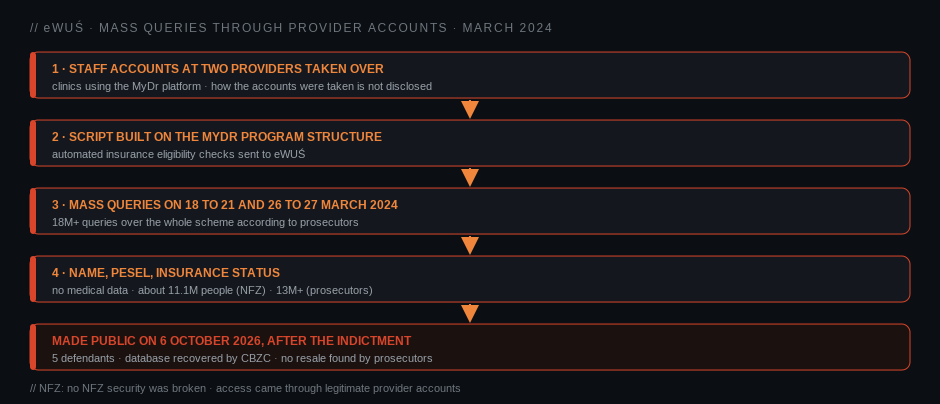
18 million queries and nothing stopped them
This is the heart of the matter. A typical clinic checks the insurance status of tens or a few hundred patients a day. According to NFZ, in six days in March data on more than 11 million people was pulled through the accounts of two facilities. Traffic like that does not look like a reception desk at work. It looks like someone combing through the registry.
NFZ spotted the anomaly and notified prosecutors and the UODO President, and the investigation opened on 8 April 2024. Detection worked, but only after the fact. What was missing was a mechanism that would have stopped the querying while it happened: a hard query limit per account and per facility, or an automatic block when traffic jumps by several orders of magnitude.
The numbers themselves hide an interesting detail. Prosecutors speak of 18 million queries and 13 million people, so some queries did not hit unique individuals. Some outlets, citing prosecutors, report that the attackers also queried artificially generated PESEL numbers. That detail is not in the statement carried by PAP, so we treat it with caution. If confirmed, eWUŚ would have worked as an oracle here: you submit a number and the system tells you whether that person exists and what they are called. And a PESEL has a predictable structure: date of birth, a serial number that encodes sex, and a check digit.
The indictment
The Regional Prosecutor's Office in Poznań sent an indictment against five men from different parts of Poland to the Regional Court in Poznań, and announced it on 5 October. The charges include breaking the security of a medical facility's IT systems, unlawful eWUŚ queries and processing of patients' data, creating and distributing software for breaking security, unauthorised access to data in patients' online accounts, and money laundering. They carry up to 8 years in prison, and in some cases up to 12. According to PAP, the defendants admitted the charges and gave extensive explanations.
Two things matter for the people affected. The Central Cybercrime Bureau (CBZC) recovered the entire unlawfully obtained database, and according to prosecutors it was not resold. That is good news with one caveat: for two and a half years nobody outside the investigation could know it, and data that has leaked once may have been copied before it was secured.
Why we are hearing about it only now
NFZ says it notified prosecutors and UODO without delay after detecting the anomaly. The broad notice to citizens came only after the indictment, though. We do not know the legal or operational reasons for that decision. It is often about protecting an investigation, and that can be justified. The problem is that a PESEL is practically impossible to change, while the tool to protect it has existed for a long time. Reserving a PESEL has been available in the mObywatel app since November 2023, and since June 2024 banks and other institutions must check those reservations. More than 11 million people could have made identity fraud much harder much earlier, had they known they should.
MyDr, again
In August we wrote about the attack on MyDr, where the attackers claimed to have stolen data on 18.8 million people. The eWUŚ case is a different event, with different perpetrators, from 2024. What links them is that a platform used by thousands of facilities became a route to data on millions of people. In 2024 that route was hijacked user accounts and a script built on the program's structure.
NFZ notes that it has no say over which software providers choose, and that providers are independent data controllers. Formally, that is true. From the point of view of the whole system's security, though, scattered responsibility means protection against abuse has to come from whoever sees all the traffic, which is the registry operator.
What to do if your data may be in this database
That is nearly one in three people in Poland, so it is reasonable to assume it includes you.
- Reserve your PESEL in mObywatel or at your municipal office. It does not stop every form of impersonation, but it makes taking a loan or signing a contract in your name harder.
- Monitor your credit activity, for example with alerts from BIK, the Polish credit bureau.
- Do not trust a caller just because they know your name and PESEL. That data may come from a leak and be used to make a scam "from the bank", "from the NFZ" or "from the clinic" sound credible.
- Report identity theft to the police or prosecutors if you see suspicious obligations. NFZ has also named a data protection officer to contact about this case.
How to defend if you run a registry or an API
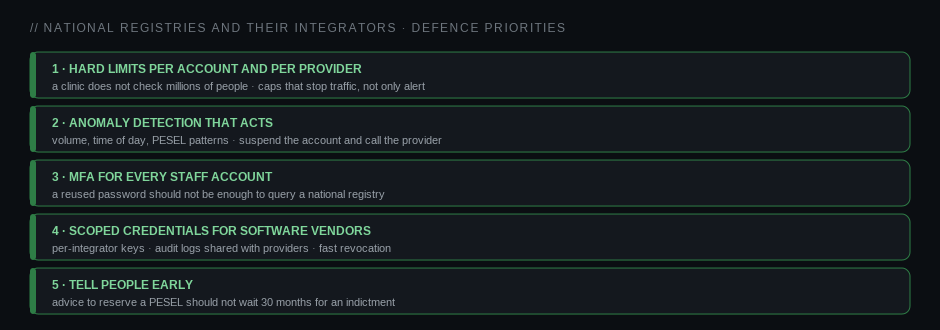
This case is a model example of abusing a legitimate interface, so the lessons apply to anyone who exposes data through an API:
- Hard limits per account and per facility. A clinic does not check millions of people. A limit that stops traffic is worth more than an alert someone reads in the morning.
- Anomaly detection that does something. Volume, time of day, sequential or non-existent PESEL numbers. Once a threshold is crossed the account is suspended and the operator calls the facility.
- MFA for every staff account. A password, even a strong one, should not be enough to query a registry covering the whole country.
- Separate credentials for software vendors. A key per integrator, logs shared with the facility and fast revocation. Then you can see whether traffic comes from the practice management system or from a script pretending to be it.
- Tell people early. Advice to reserve a PESEL does not have to wait 30 months for an indictment. It is possible to warn people without revealing investigative details.
What this means
This leak did not need a single zero-day. Hijacked accounts, a legitimate interface and missing limits were enough. It is a common pattern in API testing: the system correctly checks whether the caller may ask, but not whether the caller is asking reasonably. Under NIS2 and the amended KSC act, access management, monitoring and supply chain security are obligations for operators of large registries and for the vendors that integrate with them. We follow the same software vendor thread in the Enel-Med and Medyc incidents.
We covered the requirements on the NIS2 / KSC page. If you expose data through an API or integrate with public registries and want to check whether they can be combed through the way eWUŚ was, that is exactly the scope of our API and application penetration testing. Book a consultation.
Sources: Zero.pl · Sekurak · Portal Samorządowy (PAP) · CyberDefence24 · StopScam