Maersk: a leak through an old system inherited in an acquisition
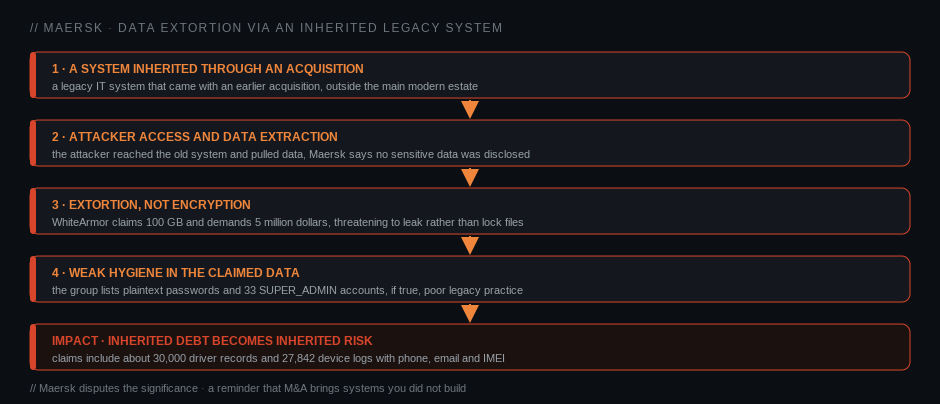
Maersk is a company that knows more about cyberattacks than most, because in 2017 NotPetya practically stopped its global logistics. This time it is different. The attackers did not encrypt anything critical. They reached an old IT system that Maersk inherited in one of its earlier acquisitions, pulled data from it, and now demand a ransom under the threat of leaking it. The WhiteArmor group talks about 100 GB of data and 5 million dollars.
Context and legality. This is educational material based on reporting by BleepingComputer, Cybernews and Privacy Guides. We separate the attacker's claims from what the company confirmed. Maersk says this concerns an old system from an acquired company and that no sensitive data was disclosed. The figures and contents come from the extortion group, so we treat them as unverified. Testing systems you do not own is legal only with the owner's written authorisation.
What the attacker claims, and what the company says
WhiteArmor issued Maersk a demand for 5 million dollars and claims it took about 100 GB of data. The list the group gives includes, among other things, data on about 30,000 drivers, plaintext passwords, 33 accounts with SUPER_ADMIN rights, signed delivery receipts, purchase orders and 27,842 mobile device logs with phone numbers, email addresses and IMEI numbers.
Maersk plays it down. It confirms that the attacker gained access to an older system inherited in an earlier acquisition, says it is investigating, and states that so far no sensitive data has been disclosed. This is the usual tension in extortion cases. The attacker paints the worst picture, the company the most cautious one. The truth usually emerges only after analysis, which is why we hold to the distinction between a claim and a confirmation.
For a company on the other side of such a demand, fast, independent verification is what counts. Before paying or publicly denying, you have to establish what actually leaked, from which system and whom it affects. Only that lets you judge your obligations to customers and the regulator, and the real risk, rather than relying on the figures the attacker gave.
Why an old system is a problem
The most interesting part of this story is not the ransom amount, but the way in. Acquisitions and mergers bring systems a company did not build itself and often does not understand in detail. Such a system can sit outside the main, modern estate, far from the current security policy. If it really held plaintext passwords and had 33 super-administrator accounts, that is a picture of practices from years ago that arrived along with the acquired company.
It is also worth noting the change in model. The attacker did not have to encrypt anything. Extracting the data and threatening to publish it was enough. With that approach an old, forgotten system holding a lot of data is as attractive a target as production, and it is often far less protected.
For Maersk there is a bitter irony in this. In 2017 NotPetya destroyed most of the company's infrastructure and became a textbook example of the impact of a single attack. Since then Maersk has invested heavily in securing the modern part of its environment. This time the weak point was not that new part, but an old system off to the side, the kind that is easy to forget. It shows that the maturity of the main environment is not enough if an unpatched island runs alongside it.
How to defend
- Inventory systems from acquisitions. After every merger, list exactly what came with the company and assess the risk of each system, especially the old ones.
- Retire or isolate legacy. A system that can no longer be properly maintained should have a shutdown date, and until then run in a cut-off zone.
- No plaintext passwords. It sounds basic, and it is still a source of the biggest leaks. Hashing and rotation are the minimum.
- Cut privileged accounts. 33 super-administrators in one system is not an exception, it is typical debt. Least privilege applies to inherited environments too.
- Build security into due diligence. A security assessment should be part of the acquisition, not a discovery after an incident.
What this means
Inherited technical debt becomes inherited risk. For NIS2 this is part of asset and supply chain management, because acquired infrastructure is your attack surface too, even if nobody on the current team built it. We broke down a similar thread, how an incident at one link hits the whole of logistics, in our piece on the week of attacks on retail. The full picture of the month is in our review of hot CVEs.
Good security due diligence in an acquisition does not end with asking whether the company has had an incident. It includes an inventory of systems, an assessment of the ones that will have to be kept, and a clear plan to retire the rest. The cost of such an analysis is usually a fraction of what a leak from a forgotten system costs a year after the deal.
If, after an acquisition, you want to know exactly what you inherited and where its weakest points are, that is the scope of our penetration testing and attack-surface review. Book a consultation.
Sources: BleepingComputer · Cybernews · Privacy Guides