Ransomware in the IDC Frontier cloud and Japan's cyber emergency
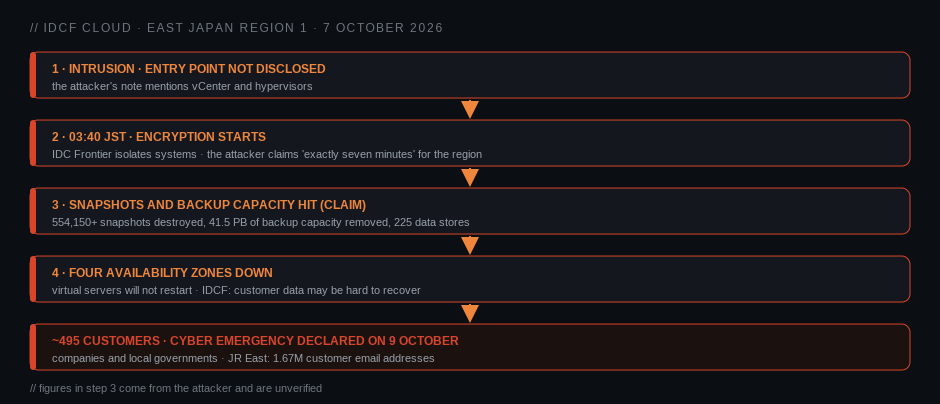
At 3:40 a.m. local time on 7 October a ransomware attack began against the East Japan Region 1 of IDCF Cloud, run by IDC Frontier, part of the SoftBank group. The company cut the network and isolated systems, but about 495 customers, both companies and local governments, lost services. A day later IDC Frontier warned that recovering customer data from the affected infrastructure might be difficult. Virtual servers in four availability zones could not be restarted.
On 9 October Japan declared a state of emergency in cyberspace. The IDC Frontier attack was not the only reason, but it was the most visible one.
Context and legality. This is educational material based on IDC Frontier's statements as reported by SC Media, BleepingComputer and SDxCentral, Financial Times reporting cited by OODA Loop, and an analysis by UltraViolet Cyber. Some numbers come only from the attacker, and we flag them clearly. Testing systems you do not own is legal only with the owner's written authorisation.
What is confirmed
IDC Frontier confirmed a ransomware attack by a "third party" on the cluster serving eastern Japan. Those affected include Fibergate, whose Wi-Fi authentication services stopped, and Medialink, with its cloud telephony and IP-PBX services, as well as public bodies, logistics companies, education and finance. According to the Financial Times, JR East said 1.67 million customer email addresses were exposed in the IDC Frontier attack.
The customer management console was down, so IDC Frontier restored machines by hand, at individual customers' request. The company advised customers to prepare a separate environment and rebuild their systems from their own backups. An emergency response headquarters, supported by SoftBank, is coordinating recovery.
Seven minutes, according to the attacker
An attacker signing as J416DY left a message and shared it on X. He claims encrypting the whole region took "exactly seven minutes", that he reached about 240 hypervisors, destroyed more than 554,000 snapshots, removed 41.5 PB of backup capacity and encrypted 225 data stores. He also claims the defenders noticed the attack at 4:25 and spent about seven hours unable to find his message. None of these numbers has been confirmed, and claims like these also serve to build pressure. The message mentions vCenter and hypervisors but does not say how the attacker got in.
Even without those numbers, the picture is consistent with how ransomware works today. According to Google research cited by SDxCentral, the virtualisation layer was targeted in about 43% of ransomware intrusions in 2025, up from 29% a year earlier. The typical scenario is scripts that shut down machines across many ESXi hosts at once, delete snapshots and backups, and then encrypt the data stores. Whoever holds the virtualisation management console holds every machine at once.
Backups that did not survive
This is the most important lesson of the case. A snapshot on the same platform is not a backup if the same admin account that controls the machines can delete it. A backup in the same administrative domain as production loses to an attacker who has taken over that domain. IDCF customers who kept their own backups outside the provider's cloud can rebuild. The rest depend on how much can be recovered by hand.
Under the shared responsibility model, the cloud provider is responsible for the infrastructure and the customer for its data. This case shows that principle from its least pleasant side.
A state of emergency in cyberspace
The Japanese government declared the emergency after a wave of attacks on well-known brands, retail chains, car rental firms, hospitals, rail operators and public institutions. After a leak of ID document photos from Times Car, Japan's Financial Services Agency advised banks to stop accepting a driving licence as the sole proof of identity. According to UltraViolet Cyber's analysis, the number of incidents in Japan in 2026 has already passed the 2025 record (503), and on 1 October the Active Cyber Defense Law took effect. It requires designated critical infrastructure operators to report incidents, including precursor events.
How to defend
- Protect the management layer like the crown jewels. vCenter and hypervisor consoles reachable only from a dedicated admin network, separate accounts with MFA, no logins from the office network.
- Immutable backups outside the production domain. Backups that no production account can delete, ideally WORM or offline, with a separate set of credentials.
- Test restoring the whole environment. Not a single file, but rebuilding systems from scratch in another location, with a measured time.
- If you are a cloud customer, keep your own copy. A contract with the provider will not give you back data that cannot be recovered.
- Detect mass operations on virtualisation. Shutting down many machines at once, deleting snapshots and changing console passwords are signals that should wake people up at night.
What this means
Cloud computing and data centre providers are in Annex I of NIS2, among digital infrastructure sectors, but the duty to protect data does not disappear on the customer's side. The IDCF incident shows that one compromised virtualisation layer can take hundreds of organisations offline at once. We described a similar pace in the JadePuffer ransomware case, where an AI agent ran the attack.
We covered the requirements on the NIS2 / KSC page. If you want to check whether your virtualisation and backups would survive an attack like this, that is the scope of our infrastructure penetration testing. Book a consultation.
Sources: SC Media · SDxCentral · OODA Loop (citing the Financial Times) · UltraViolet Cyber