The Enel-Med breach and the wave of attacks on Polish healthcare
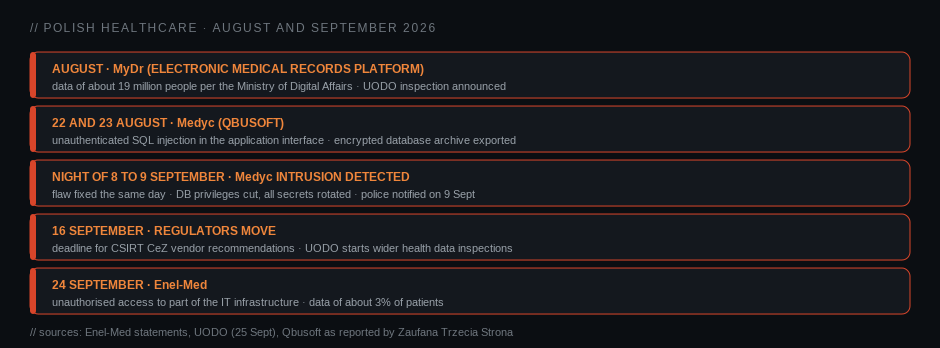
On the evening of 24 September the board of Enel-Med, a listed chain of private medical centres in Poland, learned of an incident that affected part of its IT infrastructure and data on some of its patients. A few days later the company said the breach may concern about 3% of its whole patient base. It is the third serious incident in Polish healthcare within a few weeks. In August data leaked from the MyDr platform, and in September it emerged that a SQL injection flaw in Qbusoft's Medyc application had been used to export the database of a treatment centre in Inowrocław.
Each case looks different, but together they say a lot about where patient data really lives and who protects it.
Context and legality. This is educational material based on statements from Enel-Med and UODO, Poland's data protection authority, and on media reports (including Sekurak, RMF FM, Bankier.pl and Zaufana Trzecia Strona). We consistently separate what companies and authorities have confirmed from attacker claims that cannot be verified today. We do not use stolen data or point to where it can be found. Testing systems you do not own is legal only with the owner's written authorisation.
What Enel-Med confirmed
The first statement was cautious. The company said it had learned of an IT security incident involving a breach of data confidentiality, secured its network and systems, and reported the case to the Central Cybercrime Bureau (CBZC), the CSIRT at the e-Health Centre, CERT Polska and the UODO President. It added that the incident does not materially affect its operations.
A later update added detail. According to Enel-Med there was unauthorised access to part of its IT infrastructure, the incident was quickly detected and the attack stopped, and the breach may concern about 3% of the entire patient base. The company said it will contact every patient whose data was affected individually. Its clinics are operating normally.
What do we not know? Quite a lot. Enel-Med has not said which categories of data leaked or whether medical data is among them. It has not given the number of people. Tabletowo, starting from the chain's 700,000-plus patients, estimated about 20,000 people, but that is the outlet's arithmetic, not a company figure. We do not know the attack vector. No group has publicly claimed the break-in.
Medyc: SQL injection without a login
Much more is known about the incident that broke a few weeks earlier. According to the vendor, Qbusoft, on 22 and 23 August someone exploited a SQL injection flaw in the Medyc application interface, without authentication. The result was the export of an encrypted database archive. The attack was detected on the night of 8 to 9 September, Qbusoft notified the police on 9 September, and a day later the Inowrocław centre reported the breach to UODO.
The confirmed scope for that centre is name, surname, PESEL (the Polish national ID number), address, phone and email. Name, surname and PESEL were encrypted in the database, but the vendor assumes they could be decrypted easily. It is also very likely that hospital discharge summaries leaked, because the attacker ran queries aimed at tables with medical data. The export covered the period from 1 July 2024 to 23 August 2026.
For a penetration tester this is a textbook picture. SQL injection has been known for more than twenty years, and here it could be exploited from the internet, with no account at all, in the application an addiction and psychiatric treatment centre used for patient data. Encrypting selected columns does little if the key is within reach of the same application. And since database privileges had to be reduced after the incident, the application account clearly reached further than it needed to. Qbusoft removed the flaw on the day the attack was detected, cut those privileges, forced rotation of all passwords and technical secrets and deployed continuous monitoring. Those are the right steps, only after the fact.
Attacker claims, and why not to take them at face value
A group signing itself "fingerprint" claims it stole data on 5 million people and 8 million "very private" photos. Bartosz Grodecki, head of the National Security Bureau, quoted those numbers with the caveat that they "still require official confirmation". UODO refers to media reports of up to five million people but does not confirm them. The attackers have not published any data so far.
Numbers like these have a purpose: they put pressure on the company and generate headlines. Writing about MyDr we noted that a genuine sample does not prove the size of a database. The same applies here. Until the data is published or investigators report findings, we treat 5 million as the upper bound claimed by the attacker, not as a fact.
What MyDr, Medyc and Enel-Med have in common
The first thing is vendor software. MyDr and Medyc are systems used by hundreds or thousands of facilities, so one flaw at the vendor becomes a problem for many data controllers at once. A small clinic has no security team and will not review the code of its practice management system. It trusts the vendor because it has no alternative.
The second is reporting. UODO pointed out that Qbusoft did not report the incident to CERT Polska or to the healthcare CSIRT. The Inowrocław centre, as data controller, reported the breach only after receiving final information from the vendor. When patient data passes through several companies, every link needs to know whom to notify and when.
The third is scale. According to figures cited by Rzeczpospolita, by the second half of September there had been 13 ransomware attacks on healthcare entities this year, compared with 10 in the whole of 2025.
How the state is responding
UODO has started inspections. On 16 September UODO President Mirosław Wróblewski ordered wider inspections of health data processing, running until the end of 2026, and on 25 September he announced an inspection of Qbusoft. An inspection of MyDr had been announced in August, and by 17 September UODO had received more than 50 complaints and more than 2,000 notifications from data controllers in the MyDr case.
The healthcare CSIRT and the Ministry of Health prepared security recommendations for medical software vendors, with an implementation deadline of 16 September. Deputy Prime Minister Krzysztof Gawkowski announced work on rules that would introduce mandatory certification for medical entities and limit how private companies can process medical data. There are no details or timeline yet.
What patients can do
If you use Enel-Med, wait for the company's individual notice, but do not wait with the basics. Reserve your PESEL in the mObywatel app, change your patient portal password and turn on two-factor authentication wherever you can. For the coming months, be wary of calls, texts and emails "from the clinic" or "from the NFZ" that know your details and ask for urgent action or a click on a link. Real data in a message does not prove the sender is real.
How to defend
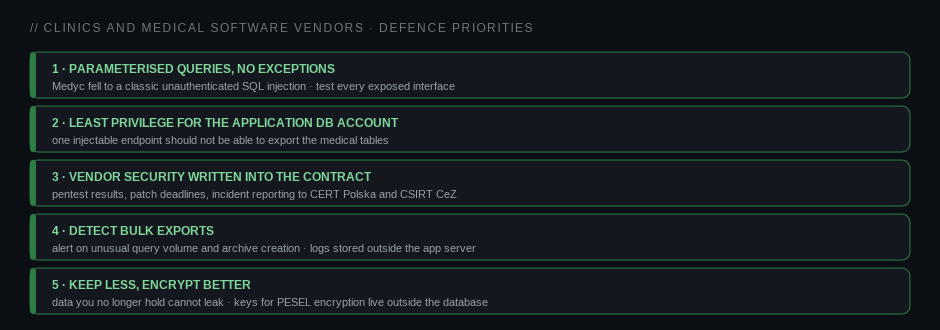
For clinics and medical software vendors, in order of priority:
- Parameterised queries, no exceptions. The Medyc SQL injection is a classic that any decent application test catches. Every interface exposed to the internet should go through a penetration test before deployment and after every major change.
- Least privilege for the database account. One vulnerable endpoint should not be able to export the medical tables. Separate accounts for separate functions, and views instead of full table access.
- Vendor security in the contract. Test results, patch deadlines, and an obligation to report incidents to CERT Polska, the healthcare CSIRT and the data controller within hours, not weeks. This is also a NIS2 and KSC supply chain requirement.
- Detect bulk exports. Alert on unusual query volume, archive creation and large outbound transfers. Keep logs outside the application server so an attacker cannot wipe them.
- Keep less, encrypt better. Data you do not hold cannot be stolen. Keys for encrypting PESEL numbers and medical data should live outside the database and out of reach of the application account.
What this means
Healthcare sits in Annex I of the NIS2 directive, among the sectors of high criticality, and the amended KSC act brings those obligations into Polish law. Three incidents in a few weeks show that the weakest link is often not the hospital but the software vendor serving hundreds of facilities. The same thread runs through our analysis of the MyDr attack and the story of the eWUŚ leak, where data on 11 million people was pulled through two clinics' accounts.
We covered the requirements on the NIS2 / KSC page. If you build or deploy medical software and want to know whether a similar flaw sits in your system before someone else finds it, that is exactly our specialisation: application and infrastructure penetration testing. Book a consultation.
Sources: Sekurak · RMF24 · Bankier.pl · Tabletowo · UODO · pelnomocnikcyber.pl (Medyc) · BNBN