CenterPoint Energy: a leak through a public API and 7.49 million claimed records
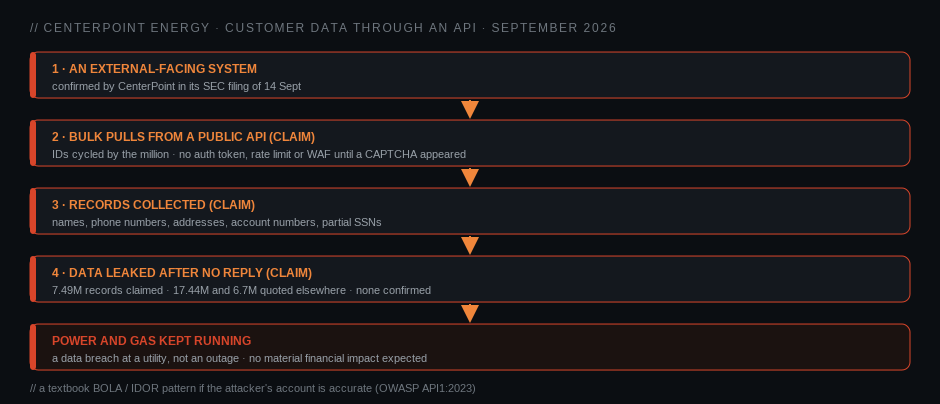
On 14 September CenterPoint Energy, a Houston-based utility serving about 7 million accounts in Texas, Indiana, Minnesota and Ohio, told the US SEC that an unauthorised party had obtained personal information of some customers through one external-facing system. The company did so after a post appeared online from someone claiming to hold a dataset of its customers. The attacker later told the press how it was done. If his version is true, this is one of the most textbook API flaws there is.
Context and legality. This is educational material based on CenterPoint's SEC filing as reported by Fox News and SQ Magazine. The numbers and the description of the method come from the attacker and have not been confirmed by the company. We treat them that way. Testing systems you do not own is legal only with the owner's written authorisation.
What the company confirmed
CenterPoint confirmed little, but it was specific. It activated its incident response procedures, brought in outside experts and established that an unauthorised party obtained personal information of some customers through one external-facing system. It did not say how many customers were affected or which data. Electricity and gas deliveries continued normally, and the company does not expect a material impact on its financial results. To detailed questions it replies that its filing speaks for itself. Class action lawsuits have already been filed in several states.
What the attacker says
The attacker signs with the string 4d722e4d656f77, which in hexadecimal spells "Mr.Meow". He claims to hold 7.49 million customer records: names, phone numbers, addresses, account numbers, bill amounts and partial Social Security numbers. By his account he pulled them in bulk from a public CenterPoint API, cycling through millions of IDs, with no authentication token, no rate limit and no WAF, until a CAPTCHA finally stopped him. When the company did not respond to his contact attempts, he published the data.
His numbers do not add up. In a forum post on 12 September he spoke of 17.44 million records, and one social media post cites 6.7 million. With 7 million accounts at the company, 7.49 million records is possible, since a record is not a person, but it is still a figure from someone with an interest in inflating it.
ID enumeration, an API classic
If the attacker's description is accurate, two flaws from the OWASP API Security Top 10 are present at once. The first is BOLA, broken object level authorisation (API1:2023): the API returns a customer's data for a given ID without checking whether the caller is entitled to it. The second is unrestricted resource consumption (API4:2023): nothing stops someone who asks for millions of IDs in sequence. The CAPTCHA that finally stopped the attacker kicked in after the data had already leaked.
BOLA tops the OWASP list for a reason. Customer IDs are often sequential numbers, helper endpoints return more fields than the interface needs, and rate limits are set so they stop only the very impatient. We described the same mechanism, mass querying without sensible limits, in the eWUŚ leak, and an IDOR flaw in the Langflow chain.
How we look for these flaws
A BOLA test is simple in principle and tedious in practice. You need at least two test accounts. You send a request as the first user, swap the object ID for one that belongs to the second, and check whether the server refuses. That has to be done for every endpoint that takes an ID: in the path, in a parameter, in the request body, in batch queries and in GraphQL. Endpoints available without a login get separate attention, because that is where it is easy to leave a feature like viewing a bill by customer number. Finally, test the limits: how many requests get through before anything reacts.
Critical infrastructure, but no outage
It is worth noting what did not happen. Power and gas kept flowing, and the leak concerned a customer service system, not grid control. That is good news, but no reason to relax. An account number, an address and part of a Social Security number are enough for very convincing scams "about an overdue electricity bill", and nearly every household in the region is a customer of the utility.
How to defend
- Object level authorisation on every request. The server checks whether the caller is entitled to that specific record, not just whether they are logged in.
- Limits and enumeration detection. Limits per client, IP address and token, and alerts on sequential IDs and unusual volume. CAPTCHA is the last line of defence, not the first.
- IDs that cannot be guessed. UUIDs instead of sequential numbers make enumeration harder, but they do not replace authorisation. They are an extra layer, not a fix.
- Inventory your APIs. Helper endpoints, old versions and APIs used only by the mobile app are typical places where controls are missing.
- Test APIs before deployment. Scanners catch some problems, but BOLA is best found by a person who understands the application's business logic.
What this means
Energy is in Annex I of NIS2, and protecting customer data is part of the operator's obligations alongside continuity of supply. This incident did not stop a single power plant, but it shows that the simplest API flaws can turn an energy company into a source of data on millions of people.
We covered the requirements on the NIS2 / KSC page. If you expose customer data through an API and want to check whether it can be pulled out one record at a time, that is exactly the scope of our API and application penetration testing. Book a consultation.
Sources: Fox News · SQ Magazine