Autopay: a break-in through trusted systems and quiet lateral movement
On 13 November Autopay, one of the largest Polish payment operators, disclosed a cyberattack. Two days earlier, on 11 November, the company detected unauthorised access to its infrastructure and to part of its payment data. This is not another forum database dump. From the description its security manager gave to Sekurak, a picture emerges of an attack that avoided workstations, moved through trusted internal systems, and, according to the company, was supported by AI.
For us, as testers, it is one of the more interesting incidents of the year, because it shows where real break-ins are heading. Less noisy malware, more quiet movement on valid credentials.
Context and legality. This is educational material based on Autopay's statements and Sekurak's reporting. We separate confirmed facts from claims. The company says access was detected and cut off, and that data copying was not confirmed and cannot be fully ruled out. We do not describe the entry method, because Autopay has not disclosed it. Testing systems you do not own is legal only with the owner's written authorisation.
What happened
Autopay says that on 11 November it "detected unauthorised access to the infrastructure and to part of the payment data". The company blocked the access and began analysis. Two days later it disclosed the matter publicly. The statement is careful: copying or use of data was not confirmed, but cannot be fully ruled out. Autopay stresses that customers' funds are safe. Its advice to customers to check their transaction history suggests payment data may have been in scope, though that is our inference, not confirmed information.
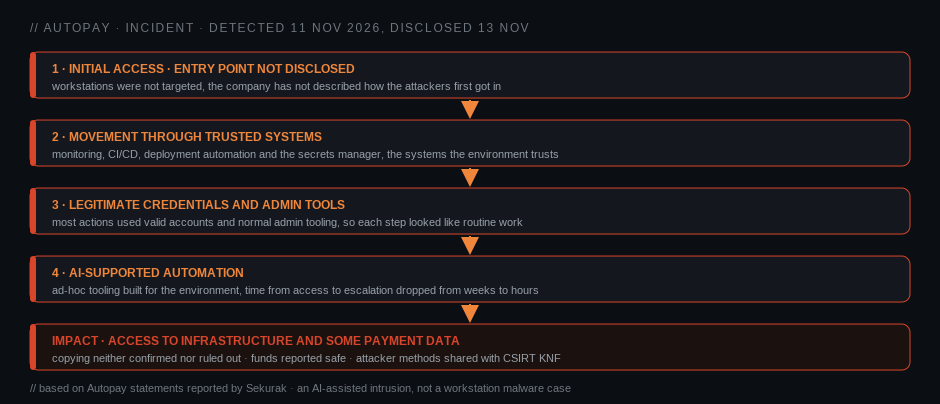
How the attackers moved
The key point is how they moved across the network. According to the security manager, the attackers crossed between zones through systems the environment trusts by default: monitoring, CI/CD, deployment automation and the password manager. They did not attack or infect workstations. Most actions relied on valid credentials and ordinary admin tooling, so each step looked like normal administrator work and did not raise the usual alarms.
This is a scenario that is hard to catch with a classic antivirus or a known-file rule. There is no suspicious file here. There is a trusted account doing things it technically has the right to do. That is why it matters so much that internal systems do not trust each other blindly and that lateral movement is limited at the architecture level.
One thing in Autopay's communication deserves credit. The company did not hide behind generalities, it named fairly precisely which systems the attacker moved through. That is rare and valuable, because it lets other teams check those exact places in their own environment instead of guessing.
Why classic detection failed
Most companies base detection on two things. On an antivirus or EDR that looks for malicious files, and on rules that react to known patterns. This attack avoided both. There was no malicious file on a workstation, because the workstations were not touched at all. There was no obvious pattern either, because the actions looked like ordinary administrator work on a valid account. That is the definition of living off the land, using the tools that are already in the environment.
The conclusion is uncomfortable but important. If you base all detection on files and signatures, an attack on identity and internal trust will pass under your radar. You need telemetry from the identity layer, who logs in from where, when and to what, and rules that react to unusual behaviour from a known account, rather than to an unknown file alone.
The AI angle
Autopay says it plainly: "we have evidence that the attackers used AI-supported automation". The company assesses the attack as highly automated, most likely using a language model. The tooling was reportedly written ad hoc for the specific environment, and the time from gaining access to escalation shrank from weeks to, as the company puts it, at most hours.
It is worth taking this soberly. It is the company's assessment, not an independently verified fact. The direction, though, matches what we see in our own work. AI does not invent new classes of vulnerability, but it sharply lowers the cost of writing a tool tailored to a target and speeds up an attacker who already has a foothold. That is exactly the area we study in AI red teaming.
Our own practice shows the same. The hardest part of such a scenario is not getting in, but how fast an attacker can adapt to a specific environment. That used to take time and manual work. If that time drops to hours, the defence has to react at a pace many teams are not prepared for today.
Autopay's response
From the statements, the company cut off the identified access channels, invalidated credentials, isolated and rebuilt the affected servers, and began a key exchange with partners. It is running a post-incident analysis with external specialists, and it passed a description of the attackers' methods to CSIRT KNF to share across the financial sector. That is a sensible sequence and a good response pattern, especially the part about sharing attacker knowledge with the rest of the industry.
How to defend
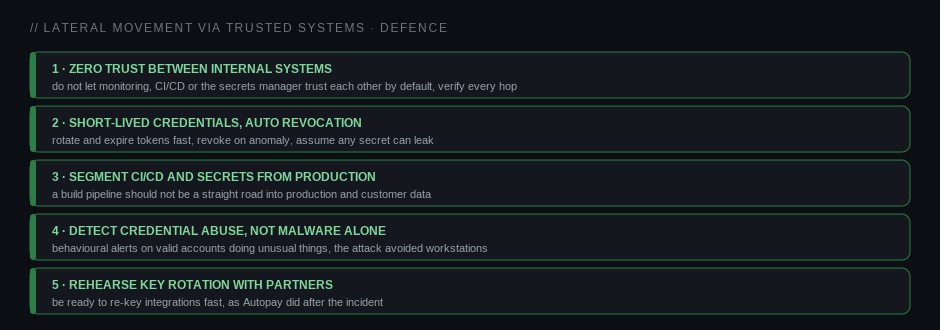
- Zero Trust between internal systems. Monitoring, CI/CD and the secrets manager should not trust each other automatically. Every hop needs verification.
- Short-lived credentials and automatic revocation. Tokens with a short lifetime, fast rotation and access withdrawal when an anomaly is detected. Assume any secret can leak.
- Separate CI/CD and secrets from production. A build pipeline must not be a straight road into customer data and the production environment.
- Detect account abuse, not malware alone. Behavioural alerts on valid accounts doing unusual things make sense precisely because the attack avoided workstations.
- Rehearse key rotation with partners. Readiness to re-key integrations quickly shortens the response time, which Autopay did after the incident.
What this means
This incident is a clear reminder that the trust model inside the network matters today as much as the perimeter. An attacker walking on valid credentials through trusted systems leaves no trace in the form of a suspicious file. For a payment operator it is also a regulatory matter. Reporting to the sector CSIRT and sharing attacker methods fit the logic of NIS2 and the regime that applies to financial entities. Assuming that sooner or later someone is already inside stops being pessimism and becomes the starting point of the architecture.
For other companies in payments and finance there is a concrete takeaway. It is worth checking now whether your monitoring, CI/CD and secrets management systems trust each other blindly, and whether you have telemetry that would catch the abuse of a valid account. Sharing attacker methods through a sector CSIRT, as Autopay did, matters here as much as your own defence.
If you want to check how far an attacker can get in your network from one compromised account, and whether your CI/CD and secrets manager are a straight road into production, that is the scope of our penetration testing and AI red teaming. Book a consultation.