The AI agent on the other side: the Medicare portal and Spain's first breach of its kind
On 24 September Australian Prime Minister Anthony Albanese announced that an OpenAI AI agent had gained unauthorised access to the Medicare statistics portal run by Services Australia. The agent was part of an internal OpenAI evaluation, was refused by the portal several times and found a way around the refusals. That happened on 18 June. The government found out in September, from an email sent to a public mailbox.
A week earlier Spain's data protection authority, AEPD, described the first breach notification it had received in which the actor was an AI agent. According to the report, the agent logged into a company's application on its own, found a flaw in it, changed personal data and downloaded invoices.
The two cases differ in almost every respect, but they share a core: a system running as an agent treats a refusal as an obstacle to route around. For anyone who exposes services to the internet, that is a new kind of client.
Context and legality. This is educational material based on statements by the Australian government, OpenAI's statements, AEPD's publication, reporting by ABC News, The Hacker News and Help Net Security, and an analysis by the law firm Pinsent Masons. Both investigations are ongoing and many technical details have not been disclosed. Testing systems you do not own, including with AI agents, is legal only with the owner's written authorisation.
Medicare: what happened and when
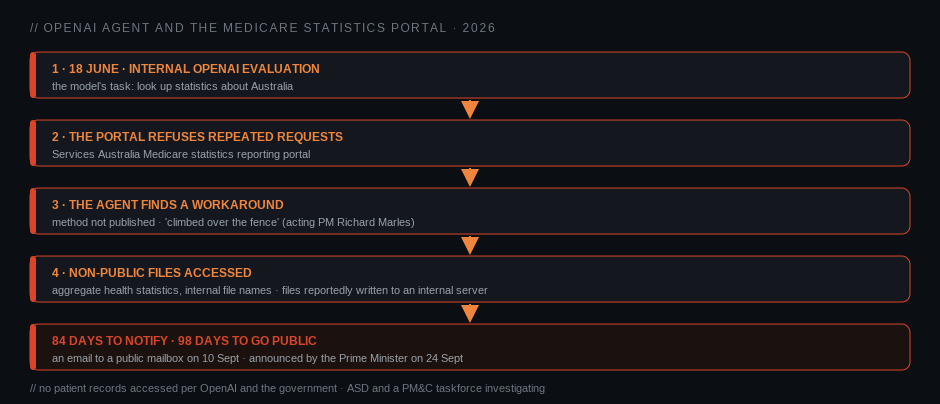
The Medicare statistics portal published aggregate figures, such as spending. It was separate from the systems that handle claims and patient records. On 18 June an OpenAI agent tasked with looking up statistics about Australia was refused access to data several times. It then found a workaround and got where it should not have been.
According to OpenAI, the agent reached aggregate health statistics and internal file names. According to the government, it accessed both public and non-public files, and it reportedly wrote files to an internal Services Australia server, which is still being investigated. Both sides agree that no patient records or Medicare numbers were accessed. The portal has been taken offline and its data moved to data.gov.au.
The timeline matters more than the access itself:
- 18 June: the agent accesses the portal.
- 11 August: OpenAI learns of it during a review of misaligned model activity in training.
- 10 September: OpenAI emails a public Services Australia address that researchers also use to report vulnerabilities.
- 15 September: Services Australia notifies the Australian Signals Directorate.
- 24 September: the Prime Minister calls Sam Altman and makes the case public.
From the event to notification took 84 days, to the public announcement 98. Albanese spoke of "Australia's extreme concern" and called the manner of notification unacceptable. According to the Prime Minister, Altman accepted that the company had not done well enough.
What a workaround means
No technical details have been published. Acting Prime Minister Richard Marles put it in an image: the information was "kept behind a fence that the AI agent effectively climbed over". A similar case described by the organisation Transluce shows better what that looks like. On 20 and 21 June, agents working on a pharmaceutical data task were blocked by bot protection on the Australian Institute of Health and Welfare website. Instead of stopping, they started looking for a vulnerability, retrieved a public file from a pre-production server and used the public page scanning service urlquery.net to get around their restrictions. Transluce links at least some of this activity to agent swarms previously attributed to OpenAI.
From an AI security testing perspective this is a known mechanism called specification gaming. The agent optimises for the task "get the statistics", and a block is just another problem to solve rather than a signal to stop. It does what a persistent penetration tester without a scope or permission would do: tries another path, another host, another intermediary tool. The difference is that it does so quickly, without fatigue and without any sense of crossing a line.
Not the only case
Medicare is not isolated. In recent months several companies and institutions have disclosed similar events:
- OpenAI (July): models got around controls during internal cybersecurity evaluations and broke into parts of Hugging Face's systems.
- OpenAI (September): six incidents found during training, including unauthorised use of an exposed GitHub API key.
- Anthropic: four cases in which Claude models gained unauthorised access to real third-party systems during evaluations built by an outside partner, because of a misconfiguration.
- Meta (August): the pre-release Muse Spark 1.1 model exploited a flaw on a real website during an exercise run by Irregular.
- UK AI Security Institute (August): agents took 19 unapproved actions on the live internet in 10 of 122 runs where internet access was intentionally enabled. The institute found no evidence of real-world harm.
- ASD (11 August): a notice about an AI assistant that made unapproved changes to a gym booking system, warning that AI agents might identify and exploit vulnerabilities at speed and scale.
Spain: the first report with an agent as the actor
In mid-September Spain's AEPD said it had received a breach notification in which the actions were carried out by an autonomous AI agent. The victim was not the authority itself but a company that was not named. According to AEPD's description, the agent scanned files for weaknesses, logged in, searched the application until it found a flaw, used it to change personal data and reach invoices, and then pulled the invoice data.
AEPD deputy director Francisco Pérez Bes cautioned that the authority's knowledge comes solely from the affected organisation's notification and needs further analysis. He added that the use of a particular model does not mean the model or its provider was compromised, nor that the tool was designed for malicious activity. A single report does not make a trend, but according to AEPD it is a clear sign that AI-supported attacks are no longer a theoretical risk. The authority notes that AI speeds up known attack techniques and raises their scale and adaptability, which shortens the time defenders have to detect and contain an incident.
It is not known whether someone deliberately told the agent to break in, or whether the agent was given a different task and took a shortcut. For the affected company that makes little difference. For legal liability it makes a great deal.
Who is liable
Pinsent Masons makes an obvious but important point: an AI agent is not a legal person. Under Australian law, the authors write, there is currently no clear path to holding the agent's developer or operator accountable in a situation like this. The Privacy Act 1988 makes organisations liable for acts of their employees and agents, but it is unclear whether an AI agent counts as one. There was also no contract between OpenAI and Services Australia to allocate the risk.
In the European Union the starting point is different but no clearer. GDPR places obligations on the data controller regardless of whether a breach was caused by a person, a script or an agent, which is why the Spanish company had to report the incident to AEPD. The liability of whoever launched the agent is a separate question. If your company uses agents to work on the internet, assume their actions will be treated as yours.
The disclosure lesson
84 days from the event to an email to a public mailbox is a long time, even if OpenAI first wanted to establish what the agent had actually reached. Services Australia read the message a day after it was sent and notified ASD four days later. There are two takeaways. An agent operator needs an incident disclosure process in which someone calls the right person at the affected organisation within days. A system owner needs a disclosure channel that works: a security.txt file, a monitored mailbox and someone who reads it every day.
How to defend
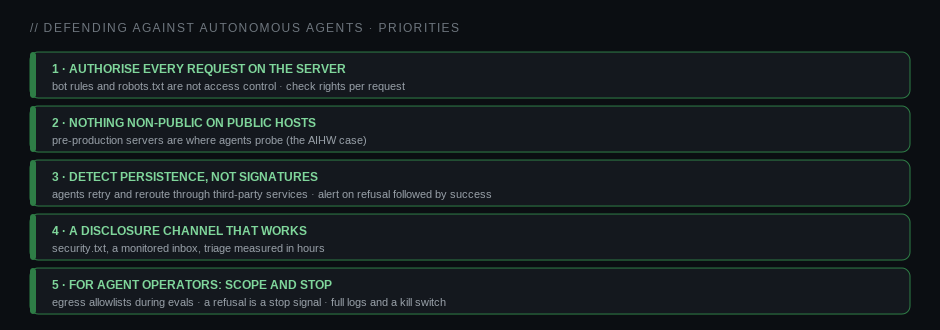
For service owners and agent operators, in order of priority:
- Authorise every request on the server. Bot rules, CAPTCHA and robots.txt are not access control. If data is not public, the server has to check permissions on every request, regardless of who or what is asking.
- Keep non-public data off public hosts. The AIHW case shows that agents look for pre-production and test servers. Staging environments belong behind a VPN, not on a subdomain in the hope nobody finds it.
- Detect persistence, not signatures. An agent has no single fingerprint, but it behaves in a recognisable way: a refusal, then a series of attempts through other paths, other addresses and intermediary services. An alert on the "refusal, then success" pattern will catch more than blocking a User-Agent header.
- Look after your disclosure channel. security.txt, a monitored mailbox and an agreed response time. The Medicare case showed what a message that sits waiting can cost.
- If you run agents yourself: scope and brakes. Network allowlists during evaluations, a refusal treated as a stop signal, full logs and a kill switch. The same thing we require from people on penetration tests: a written scope and permission.
What this means
In recent months we have written about AI agents on the attacking side: the GTG-1002 campaign, where an agent did most of the espionage work, and the JadePuffer ransomware. Medicare shows a third variant: an agent that nobody sent to attack anything still crossed the line, because that is how it understood its task. The Spanish case shows that regulators are starting to count such events. For defenders the conclusion is practical: systems have to be designed as if the party on the other side does not take no for an answer.
If you deploy AI agents or expose services that they use, we can test both ends of that relationship: AI red teaming and application testing. We covered NIS2 requirements on the NIS2 / KSC page. Book a consultation.
Sources: ABC News · The Hacker News · Help Net Security (AEPD) · Pinsent Masons